
Blockchain security is one of the most important technological advances in the last ten years. Because blockchain is such an important component of online investing, cryptocurrencies, and cyber security, it is quickly becoming a must for individuals pursuing advanced jobs in IT security. This blog covers what blockchain is, why it raises so many security concerns, and how trained IT professionals can solve those concerns.
According to a recent report, the global blockchain business is expected to be worth $20 billion by 2024. Currently, 69 percent of banks are looking at blockchain security technology to make their services more secure, consistent, and simple.
Table of Contents
What is Blockchain Technology?
Blockchain is a technology that enables consumers and businesses to store and process data by utilizing the organized distributed blocks found in a blockchain network. Each new block contains a transaction or a group of transactions that are linked to all previous layers in the form of a cryptographic chain.
How does Blockchain Work?
Blockchain operates as a distributed network that permits data decentralization, making it more secure and difficult to tamper with technology.
It is a decentralized public ledger system that allows organizations to join it via nodes to store and process data. The data saved in blocks can be accessible by the originating entity that wishes to store/process the data after verification, validation, and consent.
When a user requests a transaction using a blockchain-based application, a block is created in the blockchain system to store the transaction’s information. The block is then forwarded to every node in the distributed peer-to-peer network, which validates the transaction further. Following validation, network nodes are rewarded for the proof of work (which is an agreement among the various nodes – also known as distributed consensus). The block is then added to the current Blockchain, and the user receives a successful transaction.
Types of Blockchains
There are three kinds of blockchains that are different from regular databases. Here are the types:
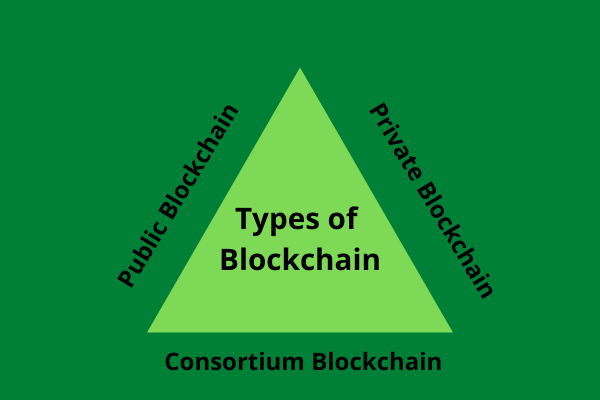
Public Blockchains
All transactions on public blockchains are totally transparent, which means that anyone can inspect the transaction details. Take, for example, Bitcoin and Ethereum.
Private Blockchains
All transactions on private blockchains are private and only available to system members who have been granted access to the private blockchain network. Hyperledger and R3 Corda are two examples.
Consortium Blockchains
Consortium blockchains are comparable to private blockchains in many ways. The main difference is that consortium blockchains are administered by a group rather than a single organization. Consortium blockchain participants might include anybody from banking institutions to governments to supply chains.
Benefits of Blockchains
The following are some of the benefits of blockchains:
Accuracy of the chain
A network of thousands of computers approves transactions on the blockchain network. This eliminates almost all human engagement in the verification process, resulting in reduced human error and a more accurate record of data. Even if a computer on the network committed a computational error, it would only affect one copy of the blockchain. That error would have to be made by at least 51 percent of the network’s computers in order to spread to the remainder of the blockchain, which is nearly impossible for a vast and developing network like Bitcoin’s.
Cost of reductions
Customers usually pay a bank to authenticate a transaction, a notary to sign a document, or a minister to conduct a marriage ceremony. The use of blockchain eliminates the necessity for third-party verification and, with it, the costs connected with it. Businesses pay a tiny fee when they accept credit card payments, for example, because banking and payment processing providers must handle those transactions. Bitcoin, on the other hand, lacks a centralized government and offers low transaction fees.
Transparency
The majority of blockchains are completely open-source software. This means that anyone with access to the code can view it. This enables auditors to verify the security of cryptocurrencies such as Bitcoin. This also implies that there is no real authority over who controls the Bitcoin code or how it is modified. As a result, anyone can propose improvements or improvements to the system. Bitcoin can be upgraded if a majority of network users believe that the new version of the code with the upgrade is sound and valuable.
How many blockchains are there?
Every day, the number of active blockchains grows at an alarming rate. There are about 10,000 active cryptocurrencies based on blockchain as of 2021, plus several hundred additional non-crypto currency blockchains.
Best practices for blockchain security
Here are some of the best practices for blockchain security:
- Using business contracts, develop and enforce endorsement agreements.
- To regulate data access in the blockchain, enable identity and access management (IAM) controls.
- To accomplish user authentication, verification, and authorization, utilize appropriate tokens such as OAUTH, OIDC, and SAML2.
- Keep identity keys safe.
- After appropriate business logic, use privileged access management (PAM) solution to secure blockchain ledger entries.
- API security best practices should be used to protect API-based transactions.
- To protect data or user information, use a data classification strategy.
- For sensitive data, use privacy-preserving technology.
- For internal and external communications, use normal TLS.
- Set up multi-factor authentication.
- Maintain strict cryptographic key management.
- Make use of the hardware security module (HSM) as well as security incident and event management (SIEM).
- Conduct vulnerability assessments and penetration testing on a regular basis (VAPT)
- To secure blockchain-based apps from vulnerabilities and data breaches, close security vulnerabilities.
- Obtain a security certification recognized by the industry for your Blockchain system.
- Enforce the solution’s compliance and other security rules.
Conclusion
Blockchain security, in a nutshell, is a complete risk assessment technique performed on a blockchain system or network to assure its security. To secure a blockchain network from online frauds, data breaches, and other cyberattacks, cybersecurity frameworks, security testing procedures, and secure coding standards are implemented.
Blockchain security provides a variety of security features for systems built on it. However, because of a lack of control and exploitable flaws, it is vulnerable to cyberattacks. As a result, doing a Blockchain security review or penetration testing is important for your company. The sooner you discover blockchain security flaws, the sooner you can close them and protect your blockchain solutions from cybercriminals.