
When it comes to data governance, too many businesses have a short attention span. Even in sectors like finance, where there is a need to meet with a variety of legal standards, firms frequently allow data governance to fall through the gaps. As a result, errors accumulate in various corporate systems. When important data is disorganized, firms risk penalties for failing to comply with regulations, increased costs for keeping and maintaining data redundancy, and other consequences. Furthermore, they cannot be certain that their business judgments are based on accurate information. To reduce those threats, good DG is required.
So, what exactly is data governance? In this blog, we will look at what data governance is and why it is important for businesses, as well as provide implementation steps.
Table of Contents
What is Data Governance?
Data governance (DG) is the process of regulating the availability, accessibility, integrity, and security of data in corporate systems, which is based on internal data guidelines and policies that also manage data usage. DG guarantees that data is consistent and reliable and that it is not misused. It is becoming increasingly important as firms encounter new data privacy requirements and rely on data analytics to help improve operations and drive corporate decision-making.
Importance of Data Governance
The necessity to comply with internal policies, legal obligations (such as SOX, GDPR, and HIPAA), frameworks (such as COBIT 5), or standards (such as ISO/IEC 38500) typically drives data governance projects. However, the importance of creating defined standards and procedures for data-related operations extends beyond compliance. Other common industry outcomes of a good DG program include:
Data governance helps in dealing with the ever-increasing flow of information.
Organizations are gathering and producing more data than ever before. Storing information you don’t need raises storage costs and makes it more difficult to locate useful information.
Data governance is required for effective data security.
Every organization’s important and personal data assets must be protected. DG can help you in preventing incidents of unintentional and intentional data change or loss by allowing you to analyze your information management policies and increase your security posture.
Regulatory compliance is enhanced by data governance.
Many laws require the keeping of particular types of records and specify the length of time they must be kept. Data governance helps organizations in meeting these standards and avoiding strict penalties and legal action.
Improved user productivity
How much time do your staff spend each day correcting erroneous data? Consider how much more productive they could be if data stewards were in charge of handling that work before it reached their level. When your staff is not allowed to work more effectively and efficiently, your firm may miss out on ideas that could push your company to the next level.
Data Governance Implementation Process
Data governance measures can be time-consuming and costly to establish. Here are the steps involved, as well as the elements that require special consideration.
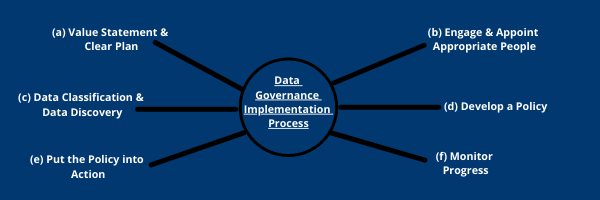
Step 1. Create a value statement and a clear plan.
Your Data Governance program begins with an evaluation of the present status of data management, roles and duties, and data-related issues. This evaluation will help you in defining your goals and creating a roadmap that highlights areas for growth as well as a strategy for reaching achievements. Remember that broad organizational changes frequently encounter resistance, so create a strong value statement and provide a complete picture of the initiatives necessary on both the business and technology sides.
Step 2. Engage and appoint the appropriate people.
Next, appoint the relevant people to handle your data and delegate responsibility to them to execute the most productive procedures for your firm. Consider your organization’s roles and duties when looking for stakeholders. Keep in mind that data governance is more than just an IT function. While IT teams are in charge of delivering the solutions required to handle your sensitive data, other team members are equally important. The DG program, for example, will require someone with decision-making authority as well as someone to develop data quality criteria.
Step 3. Data classification & data discovery
Data classification is essential in data governance strategy. It helps in the following areas:
- Identifying data that is subject to GDPR, HIPAA, CCPA, PCI, CMMC, and other standards
- Applying metadata tags, which can then be used to set up appropriate controls and streamline DG procedures.
- Managing eDiscovery processes through the use of legal hold and archiving
For successful data governance, you must first determine the data you require and how valuable it is. However, it is not a simple task. The procedure will be as follows:
- Discover all of the data that your company has stored.
- Determine its worth.
- Data should be classified and labeled (tagged) based on its value and sensitivity level.
- Map out where it’s maintained.
The data discovery process allows you to locate, identify, and classify data, which allows you to determine how important that data is – and how vulnerable it may be.
Step 4. Develop a policy for data governance
A data governance policy establishes the standards for ensuring good data governance in a business. A data governance policy will often cover the following topics:
- The data governance program’s scope, goal, and structure
- Definitions of the roles responsible for the generation and usage of certain data sets
- Rules that ensure adherence to applicable laws, rules, and standards
- Data ownership, accessibility, protection, categorization, usage, storage, and removal rules and principles for data quality audits, including key performance indicators.
Step 5. Put the policy into action.
Because implementing a data governance strategy can take months, it is best, to begin with, the most critical business processes. Consider variables such as regulatory obligations, the effect on company efforts, and corporate priorities when choosing.
Step 6. Monitor progress on a regular basis.
Data governance is a continuous activity, not a one-time project. Your DG program must evolve as internal policies, government regulations, and company requirements change. Make improvements as needed to ensure that your processes and technologies continue supporting the program’s aims.
Conclusion
Organizations today have massive volumes of data on their customers, consumers, suppliers, patients, workers, and other stakeholders. An organization will be more successful if this information is used correctly to better understand the market and its target audience. The same data governance will ensure that your organization’s data is trusted, well-documented, and easy to find and access, as well as secure, compliant, and confidential.
Determine that your company is well-positioned to optimize data governance expenditures while minimizing the risk of data breaches.