
Every year, data breaches disclose millions of people’s private data, causing many businesses to lose millions. In fact, the average cost of a data breach so far in 2021 is $4.24 million. Among all the exposed data types, Personally Identifiable Information (PII) is the most damaging.
As a result, data security has become a major priority for many enterprises. For this reason, data masking has become an essential method for many firms to protect their sensitive data.
Table of Contents
What is Data Masking?
Data masking is a technique for creating a fraudulent but realistic version of your organization’s data. The purpose is to secure sensitive data while also offering a functional substitute when real data is not required, such as in user training, sales demos, or software testing.
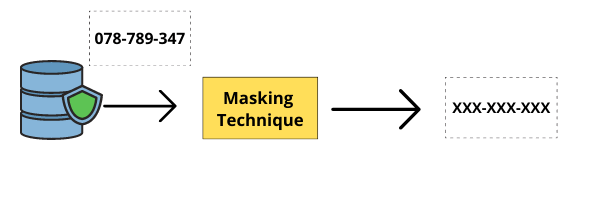
Data masking processes modify the values of data while maintaining the same format. The goal is to develop a version that cannot be decoded or reverse engineered. Character shuffling, word or character substitution, and encryption are all methods for modifying the data.
Types of Data Masking
There are many data masking types that are often used to encrypt data.
Static Data Masking
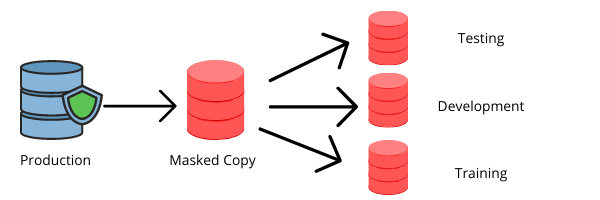
Static data masking processes can help in creating a fresh copy of the database. The method modifies all sensitive data until a safe copy of the information can be shared. Typically, the procedure includes producing a backup copy of a production database, importing it to a separate environment, removing any unwanted data, and then masking data while it is in stasis. After that, the masked copy can be moved to the preferred destination.
Deterministic Data Masking
It includes mapping two sets of data with the same type of data so that one value is always changed by another value. For example, the name “John Smith” is always changed with “Jim Jameson” in any database where it appears. This method is useful in many situations, but it is generally less secure.
On-the-fly Data Masking
Masking data as it is transported from production systems to trial or development systems before saving it to disk. Organizations that often release software cannot generate a backup copy of the data source and conceal it; instead, they require a method to continuously transport data from production to various test environments.
When necessary, masking sends smaller sections of masked data on the fly. Each masked data subset is saved in the development/test environment for usage by the non-production system.
To avoid compliance and security difficulties, it is important to apply on-the-fly masking to any feed from a production system to a development environment at the start of a development project.
What Types of Data need Masking?
- Personally identifiable information (PII): Any data that may be used to identify a specific individual. Full name, social security number, driver’s license number, and card number, for example.
- Protected health information (PHI): PHI consists of demographic information, health history, test and laboratory findings, mental health issues, insurance information, and other data that a healthcare practitioner obtains in order to determine appropriate care.
- Payment card information (PCI-DSS): There is an information security standard that businesses must adhere to when dealing with branded credit cards from the main card schemes.
- Intellectual property (IP): IP refers to mind creations such as inventions, literary and creative works, designs, and commercial symbols, names, and pictures.
Data Masking Techniques
IT experts can use a variety of techniques to protect data. Some of them are following below:
Data Encryption
When data is encrypted, it is considered useless unless the viewer knows the decryption key. The encryption algorithm essentially masks data. This is the most secure type of data masking, but it is also the most difficult to use because it requires continuing data encryption technology as well as systems to manage and exchange encryption keys.
Data Scrambling
Characters are rearranged in a random order, and the original content is replaced. In a test database, for example, an ID number such as 76498 in a production database could be changed by 84967. This method is fairly easy to develop, however it can only be used for certain types of data and is less safe.
Value Variance
A function, such as the difference between the lowest and highest value in a series, replaces the original data values. For example, if a customer buys multiple items, the purchase price can be substituted with a range between the highest and lowest price paid. This can provide relevant data for a variety of uses while keeping the original dataset private.
Data Masking Best Practices
Below are some of the best practices for data masking:
Establish the Project Scope
Companies must understand what information needs to be secured, who is authorized to see it, which apps use the data, and where it exists, both in production and non-production domains, in order to perform data masking properly. While this may appear simple on paper, due to the complexity of operations and various lines of business, this procedure may require a significant amount of effort and must be designed as a separate stage of the project.
Maintain Referential Integrity
Referential integrity requires that each “kind” of information originating from a particular application be masked with the same algorithm.
A single data masking solution used throughout the entire enterprise is not feasible in large organizations. Because of budget/business considerations, various IT administration methods, or different security/regulatory requirements, each line of business may be required to develop its own data masking.
When working with the same type of data, ensure that different data masking technologies and processes are integrated across the business. This will help to avoid problems later on when data needs to be used across business divisions.
Prevent the Data Masking Algorithms
It is important to think about how to protect the data masking algorithms, as well as alternate data sets or dictionaries used to encrypt the data. Because only authorized users should have access to the actual data, these algorithms must be treated with extreme precaution. If someone can figure out which recurring masking strategies are being used, they can reverse engineer big blocks of sensitive data.