
In today’s world, any organization involved in payment processing must be able to provide effective data security measures. A multi-pronged method combining EMV, encryption, and credit card tokenization is the most effective method for protecting cardholder data. This guide will concentrate on tokenization, with the understanding that it is only one component of a comprehensive data security strategy.
Tokenization replaces sensitive cardholder data with a non-valuable “token.” This improves data security by safeguarding actual information and limiting its visibility. Credit card tokenization is an essential component of maintaining customer security when they pay for goods and services for independent software vendors (ISVs) and their merchants. This blog explores the tokenization process and shares some of the benefits of credit card tokenization.
Table of Contents
What is Credit Card Tokenization?
Credit card tokenization is the process of completely erasing sensitive information from a company’s internal network by substituting it with a completely random, different placeholder known as a token. For example, if a card number was 1234 5678 8773 4091, the result would be E60TY4GQ27X. This token is being used to obtain, retrieve, and store a customer’s credit card details, ensuring greater security for both the consumer and your organization.
This credit card safety precaution is being implemented by an increasing number of businesses across the United States. Many people find it simple to use, more protected than end-to-end encryption, and less expensive, but what else should you know before determining if tokenization is right for your company?
How does Credit Card Tokenization Works?
Credit card tokenization replaces sensitive customer data with a one-time alphabetic ID that has no significance or relation to the account’s holder.
This completely random token is used to securely access, pass, transfer, and collect credit card information from customers. Tokens do not contain any personally identifiable information about consumers. They function more like maps, indicating where the customer’s bank stores this sensitive information within their own systems.
Tokens are created using mathematical algorithms and cannot be reversed. Only when the transaction is complete can the tokens be opened. These tokens have no meaning or value from outside your system. Even if hackers come into contact with your customer’s data while it is being processed, they will be unable to use it.
The tokenized credit card transaction works as follows:
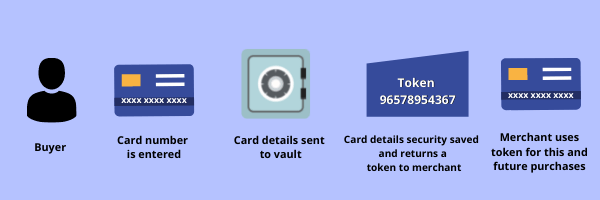
- The cardholder begins the transaction and needs to enter sensitive credit card information.
- In the form of a token, the credit card information is sent to the merchant acquiring bank.
- The token is sent to the credit card networks for approval by the acquirer.
- When the customer’s data is approved, it is stored in the bank’s virtual private vaults, and the token is checked to the customer’s account number.
- The bank verifies the funds and approves or denies the transaction.
- If the approval is successful, the merchant receives a unique token that can be used for current and future transactions.
Customers do not need to do anything differently because the full tokenized credit card payment procedure occurs behind the scenes.
Benefits of Credit Card Tokenization
It goes without saying that credit card tokenization greatly improves payment security. Tokenization is a good way to keep your customers’ payment details safe from both external cybercriminals and potential internal issues. Some more benefits are:
- Completely random tokens can only be read by the payment processor and cannot be monetized even if they have been exposed. As a result, when a token traverses the systems, anonymous thieves and cybercriminals have fewer opportunities to commit a cybercrime.
- Many organizations that store and retrieve sensitive data on their networks frequently struggle to meet PCI DSS standards. If a data breach occurs, a lack of PCI compliance may result in fines imposed by the PCI Council.
- Tokenization enables merchants to comply with PCI DSS while incurring minimal liabilities and security costs.
- By removing credit card information from your network, you reduce the likelihood of a data breach. As a result, you don’t have to invest as many funds and resources in data protection because credit card tokenization has done it for you.
- Tokenization technology can also be used to protect other confidential business data such as passwords, addresses, confidential documents, and customer accounts.
Tokenization Vs Encryption
While both are effective tools for combating credit card fraud, tokenization and encryption are frequently confused. So, how tokenization and encryption are different from each other?
Encryption is a type of cryptography that converts sensitive information into difficult-to-read code. Each number, word, and space on a card is concealed by a different one chosen by a system based on a complex encryption algorithm. In the end, the encoded data should be decrypted using the key or password.
The most major difference between tokenization and encryption is that encryption is recoverable. Encrypted data can be restored to its original form at any time – as long as you remember the algorithm.
Despite the fact that encrypted data is “breakable,” the PCI Council considers it to be sensitive. Meeting compliance standards with encryption, on the other hand, is much more pricey than doing so with tokenization.
For transactions where the card is present physically, encryption is one of the most effective card data protection methods. Nonetheless, when it comes to payments where the card is not present, tokenization provides significantly better protection.
To properly protect sensitive transmitted data and comply with PCI DSS requirements, experts recommend combining encryption and tokenization.
Tokenization and Your Business
If your business meets, transfers, processes, or stores credit card information in a shopfront, online, by mobile, or by mail, you must comply with PCI DSS every year. Maintaining compliance with these regulations can be difficult, and no one wants to be held accountable in the event of criminal activity. With tokenization, you can rest assured that your customer’s information is protected, all of your transactions are safe, and the PCI requirements are met, all at a low cost. Credit card fraud is at an all-time low when combined with security measures such as EMV readers and smart cards.