
The security of information, applications, and processes are essential in today’s digital age. Cyber resilience is a concept that is growing rapidly. It is a broad category that includes data protection, IT infrastructure, business operations, and organizational continuity.
Table of Contents
What is Cyber Resilience?
Cyber resilience is your ability to consider, respond to, and stabilize from cyberattacks and data breaches while remaining operationally effective. When an organization is cyber resilient, it can protect against cyber threats, maintain cybersecurity threats effectively, and ensure business continuity during and after cybersecurity incidents.
Cyber resilience, like attack surface management, has emerged in recent years as traditional security controls like penetration testing and protection questionnaires are no longer sufficient to reduce cyber risk.
The goal of cyber resilience is to keep your ability to offer goods and services available at all times. This can include the ability to regenerate regular mechanisms as well as the ability to constantly change or modify methods on an as-needed basis, even if regular methods have failed, including during a crisis or a security breach.
How Does Cyber Resilience Work?
Cyber resilience works by providing multiple layers of defense. There is no silver bullet for dealing with constantly evolving threats or ensuring seamless business continuity in the face of unexpected events. Defense-in-depth strategies, which do not focus on a specific solution, address the problem of an apparently infinite number of attack vectors and data loss scenarios.
Instead, defense-in-depth depends on various technologies to make sure that users, networks, and devices are secure and that affected data can be recovered quickly. Some reputable cyber resilience solutions cover a wide range of prevention and recovery options by offering unrivaled security and data backup and restore solutions, such as the ability to train your employees, block threats, defend your devices, back up your data and recover from setbacks easily.
Cyber Resilience vs Cybersecurity
Cybersecurity is a part of cyber resilience, which is made up of several sub-components, including endpoint security, network security, and security awareness training. These are all part of the broader category known as “cybersecurity.”
When we include data backup and recovery to the mix—which involves services like endpoint backup and restore, backup for Microsoft 365, server sync, migration facilities, and more—we begin to discuss cyber resilience in a broader context. We call it cyber resilience when data security, backup, and recovery help to keep your business online.
Why Cyber Resilience is Important?
Traditional security measures are no longer suitable for ensuring adequate information security, data protection, and network security. Indeed, many CISOs and IT security teams now expect attackers to gain unauthorized entry into their organization.
Every day, adverse cyber events have a negative impact on the confidentiality, integrity, and availability of organizations. These events can be intentional or unintentional (for example, a failed software update), and they can be caused by humans, nature, or a mixture of the two.
Today, being ready to respond to and recover from data breaches is just as important as being able to prevent them.
Benefits of Cyber Resilience
Before, during, and after data breaches, cyber resilience strategies provide a variety of benefits:
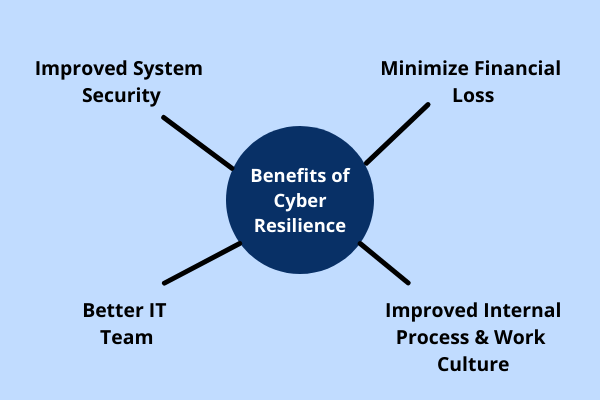
Improved system security
Cyber resilience is useful for more than just responding to and surviving an attack. It can also assist your organization in developing strategies to improve IT governance, increase security and safety across key assets, strengthen data protection efforts, mitigate the effects of natural disasters, and reduce errors.
Minimize Financial loss
No matter how good your security is, no one is immune to cyberattacks or misconfiguration. The average global cost of data breaches is now $3.92 million, which is enough to bankrupt many small to medium-sized businesses. Aside from the financial costs, the reputational impact of data breaches is growing as a result of the implementation of general data protection legislation and strict data breach notification specifications.
Better IT Team
One of the underrated benefits of cyber resilience is that it enhances your IT department’s day-to-day operations. A hands-on IT team not only enhances an organization’s responsiveness to threats but also helps to maintain day-to-day operations running smoothly.
Internal processes and work culture have been improved
Cyber resilience is a collaborative effort. Every employee is responsible to protect your organization’s sensitive data to make a sure adequate incident response. Sensitive information and hard assets are far less at risk when people are empowered to take security very seriously.
How can Cyber Resilience be Enhanced?
A successful cyber resiliency strategy will incorporate elements of various cybersecurity solutions. These are some examples:
Data security
Data safety is a vital component of both cybersecurity and cyber resilience. This includes both structured and unstructured data. You must be able to collect and analyze what you have and derive important insights in order to comply with privacy and other legal requirements.
Identity & Access Management
The capacity to maintain the “who” (employees, customers) and “what” (devices, services) that obtain your systems and data is known as identity and access management. It allows you to create trusted identities with the appropriate level of access. Recognizing the normal patterns of these identities makes identifying abnormal patterns easier.
Application Security
Application security begins with the development of your application. Testing must be scalable, adaptable for on-premises or on-demand deployment, and integrate with your DevOps. It should have developer-friendly procedures and code that is easy to navigate.
Artificial Intelligence & Machine Learning
AI and machine learning (AI/ML) are significant contributors to useful cyber resilience. With mountains of data produced by security solutions, using systems that can evaluate behaviors and risk and process automation response can significantly improve an organization’s ability to smartly adapt to vulnerabilities and threats.
Conclusion
Cybersecurity attacks have increased and evolving by the day. Organizations should base their opinions on the fact that a malfunction in their network defenses is imminent, and they should devise a mechanism to mitigate the harm. This is where cybersecurity resiliency comes into play. In the event of an attack, cyber resilience will help organizations minimize damage while maintaining service and business continuity.