
In cyber security, data encryption is the process of converting data from an understandable form to an encoded format. Data that has been encrypted can only be read or used after it has been decrypted.
Encryption is the cornerstone of data security. It is the simplest and most important technique to ensure that the information on a computer system cannot be stolen and accessed by someone who wants to use it for malicious purposes.
Individual users and big organizations both use data security encryption to secure user information transferred between a browser and a server. This data could include anything from financial information to personal information. Data encryption software, often known as an encryption algorithm or cipher, is used to create an encryption scheme that can theoretically be broken only with massive amounts of computational power.
Table of Contents
Most Common Data Encryption Methods
Asymmetric and symmetric encryption are the two most common encryption methods. The names indicate if the same key is used for encryption and decryption:
- Symmetric encryption keys: This is commonly known as private key encryption, are used. Because the key used to encode is the same as the key needed to decode, it is best suited for single users and closed systems. Otherwise, the key must be delivered to the recipient. If it is intercepted by a third party, such as a hacker, the danger of compromise increases. This method is more efficient than the asymmetric method.
- Asymmetric encryption keys: This type implements two different keys — public and private — that are mathematically linked together. The keys are essentially huge numbers that have been paired but are not identical, hence the word asymmetric. The owner keeps the private key private, while the public key is either shared with authorized recipients or made available to the general public.
Only the recipient’s private key may decrypt data encrypted using the recipient’s public key.
How Does Data Encryption Work?
When data or information is shared over the internet, it moves through a system of network devices all over the world that are part of the public internet. As data flows across the public internet, it may be compromised or stolen by hackers. Users can avoid this by installing specific software or hardware that ensures the secure flow of data or information. In network security, these activities are referred to as encryption.
Encryption is the process of transforming human-readable plaintext into an incomprehensible text known as ciphertext. Essentially, this includes changing understandable data into data that appears random. Encryption is done by the use of a cryptographic key, which is a set of mathematical values on which both the sender and the recipient agree. The key is used by the recipient to decrypt the data, converting it back to readable plaintext.
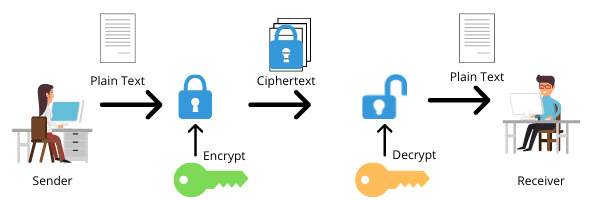
The more complex the cryptographic key, the more secure the encryption - since brute force attacks are less likely to decrypt it (i.e. trying random numbers until the correct combination is guessed).
Passwords are also protected using encryption. Password encryption methods jumble your password so that hackers cannot read it and helps in preventing various password attacks.
Database Encryption
Data is often input by users, processed by programs, and then saved in a database in most modern applications. At a more basic level, the database is made up of files that are controlled by an operating system and are saved on physical media such as a flash hard drive.
Encryption can be done at four different levels:
- Application level encryption—data is encrypted before it is written to the database by the application that edits or generates it. This makes it easy to customize the encryption procedure to each user depending on their roles and permissions.
- Database encryption—encrypting the entire database or parts of it to secure the data. The database system stores and manages encryption keys.
- File system level encryption—allows system users to encrypt folders and individual files. File-level encryption uses software agents that capture read and write disk calls and use policies to determine whether the data needs to be decrypted or encrypted. It can encrypt databases as well as any other data stored in folders, just like full disk encryption.
- Full disk encryption—converts data on a hard drive automatically into a format that cannot be interpreted without the key. Databases, like any other data, are encrypted on the hard drive.
Benefits of Data Encryption
The following are the benefits of data encryption:
Encryption helps in the preservation of data integrity.
Hackers can change data to commit fraud in addition to stealing it. While competent hackers can change encrypted data, recipients will be able to identify the corruption, allowing for a quick response.
Encryption helps companies in adhering to regulations.
Many businesses, such as financial services and healthcare providers, have severe restrictions governing how consumer data is handled and preserved. Encryption helps enterprises in meeting these standards and maintaining compliance.
Encryption is beneficial when transferring data to cloud storage.
As more people and companies store their data in the cloud, cloud security becomes extremely important. Encrypted storage helps in the protection of the data’s privacy. Users must guarantee that data is encrypted in transit, in use, and at rest in storage.
Protects data across device
Most of us use many devices in our daily lives, and moving data from one device to another might be harmful. Encryption technology helps in the protection of data across devices, even during transfer. Additional security measures, such as enhanced authentication, help in discouraging unauthorized users.
Intellectual property is secured via data encryption.
To prevent reverse engineering and unauthorized use or reproduction of copyrighted information, digital rights management systems encrypt data at rest – in this example, intellectual property such as songs or software.
Conclusion
While data encryption may appear to be a difficult and sophisticated procedure, a good data loss prevention technique handles it on a daily basis. Data encryption does not have to be a problem that your company seeks to handle on its own. Choose a top data loss prevention program that includes data encryption as well as device, email, and application control to ensure the safety of your data.
















Pingback: 7 Data Loss Prevention Best Practices (DLP) - Security Pilgrim