
End-to-end encryption has been announced by communications services varying from WhatsApp to Zoom in recent years. What does this indicate? Encryption, taken individually, is a fairly simple concept: It converts or changes data so that it cannot be read. But what exactly does “end-to-end” mean? What are its advantages and disadvantages? This blog explains it simply without getting into the underlying math and technical terms.
Table of Contents
What is End-to-End Encryption?
End-to-end encryption (E2EE) is a protected communication method that restricts third parties from accessing data as it travels from one end system or pc to another.
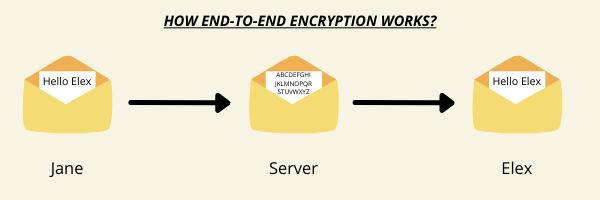
In E2EE, the encrypted data on the sender’s system or network can only be decrypted by the intended recipient. The message cannot be read or compromised as it travels to its destination by an internet service provider (ISP), application service provider (ASP), hacker, or any other organization or service.
How End-to-End Encryption Works?
Endpoints store the secret key used to encrypt and decrypt messages. This method uses public-key encryption.
Public key encryption, also known as asymmetric encryption, uses a public key that can be shared with others as well as a private key. When a public key is shared, others can use it to encrypt a message and send it to the owner of the public key. Only the associated private key, also known as the decryption key, can be used to decrypt the message.
Messages are almost always passed between two parties involved in an exchange via an intermediary in online communications. Typically, that intermediary is a server connected to an ISP, a telecom company, or a variety of other companies. The public key infrastructure used by E2EE ensures that intermediaries cannot pay any attention to the messages being sent.
To ensure that a public key is a legitimate key created by the intended recipient, embed it in a certificate that has been digitally signed by an accredited certificate authority (CA). Because the CA’s public key is widely spread and known, its veracity can be relied upon; a certificate signed with that public key is presumed to be authentic. Because the certificate links the user’s name and public key, the CA would presumably refuse to sign a certificate that linked a different public key to the same name.
How is End-to-End Encryption Used?
When data security is required, such as in the finance, healthcare, and telecommunication industries, end-to-end encryption is used. It is frequently used to support businesses in complying with data security and privacy regulations and laws.
To secure information, such as customer credit card data, an electronic point-of-sale (POS) system provider, for example, would include E2EE in its offering. Incorporating E2EE would also facilitate a retailer in meeting the Payment Card Industry Data Security Standard (PCI DSS), which requires that card numbers, magnetic stripe information, and security codes not be kept on client devices.
What End-to-End Encryption Protects Against?
Pry eyes: Because only the sender and intended recipient have the keys to decrypt the message, E2EE prevents anyone other than the sender and intended receiver from reading message information in transit. Even though the message may be visible to an internet gateway that is assisting in the transmission of the message, it will not be legible.
Tampering with encrypted messages: E2EE also prevents tampering with encrypted messages. Because there is no way to expectedly change a message encrypted in this manner, any attempts to change it would be obvious.
Advantages of End-to-End Encryption
The key advantage of end-to-end encryption is that it prevents transmitted data from being read by anyone other than the recipient. It’s as if when you sent out a letter, you placed it in a box that was physically impossible to access — invulnerable to any sledgehammer, saw, lockpick, or another tool — except by the addressee. End-to-end encryption protects your communication’s privacy.
In the physical world, creating an invincible box is impossible, but it is possible in the world of information. Expert mathematicians are constantly developing new encryption systems and strengthening existing ones.
Another benefit of end-to-end encrypted messages being unreadable by anyone other than the recipient is that no one can compromise the message. Modern data encryption methods are designed in such a way that if the encrypted data is changed, the message becomes garbled on decryption, highlighting the problem immediately. There is no way to make reasonable changes to an encrypted message — that is, the text cannot be replaced.
This ensures the consistency of your communication. If you obtain a successfully decrypted message, you can be confident that it is the same message that was sent to you and was not tinkered with in transit (in fact, a messaging app will do that for you automatically).
What End-to-End Encryption Doesn’t Protect Against?
Although the E2EE key exchange is thought to be unbreakable using known algorithms and current computing power, there have been several evaluations of potential weaknesses in the encryption technique, including the three listed below:
Metadata: While E2EE secures the information contained within a message, it does not conceal information about the message itself, such as the date and time it was sent or the recipients in the exchange. This metadata could provide malicious actors interested in the encrypted information with hints as to where they might be able to retrieve the information once it has been decrypted.
Compromised Endpoints: An hacker may be able to see a message before it is encoded or after it has been decrypted if either endpoint has been compromised. Attackers could also extract keys from compromised endpoints and use a stolen public key to launch a man-in-the-middle attack.
Vulnerable Intermediaries: Intermediaries who are vulnerable. Sometimes providers claim to deliver end-to-end encryption when in reality they only provide encryption in transit. The data could be stored on an intermediary server and accessed from there.
Conclusion
End-to-end encryption, besides its limitations, is currently the safest way to transfer private information, which is why more and more communication systems are adopting it. That’s a positive thing.