

Spear phishing, not to be confused with an aquatic hunt on a tropical holiday, is a targeted cyberattack directed at a single individual or organization with the intention of obtaining private information for malicious reasons.
As per the name, it’s a type of phishing — and a popular one at that, with 65 percent of all known cybercriminal groups reportedly using this specialized strategy to obtain compromising information for victims.
However, to understand spear phishing properly, you first need to know about phishing.
Table of Contents
What is Spear Phishing?
Spear phishing is a type of cybercrime that uses emails to launch targeted attacks on individuals and businesses. Attackers use clever ways to gather personal information about their targets and then send emails that appear to be familiar and trustworthy.
These emails frequently include attachments with malicious links to malware, ransomware, or spyware. Furthermore, the email will directly request that the recipient reply immediately, for example, by transferring a certain amount of money or sending personal information such as a banking password.
Because the emails are written in a friendly tone and contain personal information about the receiver, victims wrongly assume they know and trust the sender and reply to the request.
Individual Spear Phishing Attack
Cybercriminals act as a trusted business, such as a bank or a popular online marketplace such as Amazon. The email could be designed to be a transaction confirmation or a shipping notification. The goal is to persuade the recipient to open the email and click on an infected link or to give confidential information that can then be used to perform other cybercrimes.
Business Spear Phishing Attack
Typically, hackers target two or three employees within an organization. The email often appears to be from the targeted employees’ manager and instructs them to transfer money, reveal passwords, or other confidential company information. The email’s tone is urgent, leading the recipients to believe that if they do not act, the company will be jeopardized.
How Does Spear Phishing Work?
Spear phishing may seem to be a simple activity, but spear phishing emails have improved in recent years and are now exceedingly difficult to detect without foreknowledge of spear-phishing protection. Victims who post personal information on the internet are targeted by spear phishing attackers. While browsing a social networking site, they may look at individual profiles. They will be able to easily find a person’s email address, friends list, geographic area, and any posts regarding recently bought devices from a profile. With this information, the attacker may pretend as a friend or a familiar entity and send a persuasive but fake message to their target.
To increase their chances of success, these messages often include urgent reasons for why they require sensitive information. Victims are instructed to open a malicious file or click on a link that will take them to a fraudulent website where they will be requested to submit passwords, account numbers, PINs, and access codes. An attacker acting as a friend may request usernames and passwords for other services, such as Facebook, in order to access posted pictures. In reality, the attackers will use that password or variants of it to get access to many websites containing sensitive information such as credit card numbers or Social Security numbers.
Once cybercriminals have collected enough sensitive information, they can gain access to bank accounts or even create a new identity using the information of their victim. After users click on links or open attachments offered in communications, spear phishing can trick them into downloading malware or malicious software.
Spear Phishing Vs Phishing
Phishing and spear phishing are two types of email attacks that are intended to trick you into completing a specific action, such as clicking on a malicious link or file. The main difference between them is one of targeting.
Phishing emails are sent to a large number of people at random, with the expectation that only a small percentage will react. An apparently official email from, for example, a well-known delivery business could appear, stating, “Your package has been delayed, check here for details.” If you click the link, malware may be put into your device, or you may be directed to a fake website where you must provide your name and address. That data would then be sold illegally or used in fraud or identity theft.
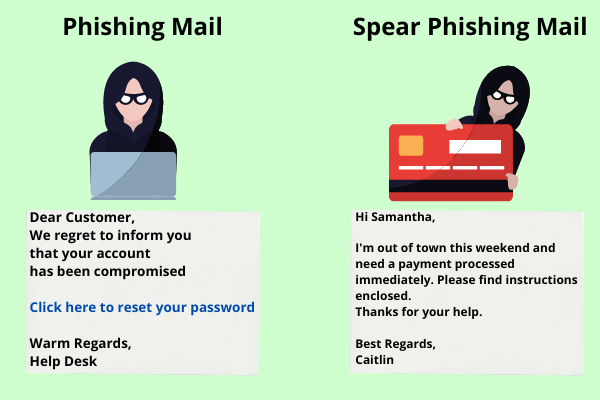
Spear phishing emails are thoughtfully designed to get a single response from a single target. Using social media and other publicly available information, criminals identify an individual target within an organization and create a false email tailored to that person. For example, if you post on social media that you will be visiting Chicago soon, you may receive an email from a colleague (supposedly) saying, “Hey, while you’re in Chicago, you’ve got to eat at Joe’s Grill, check out their menu.” When you click the link, malware gets installed on your computer while you’re browsing the menu.
Tips to Avoid Spear Phishing Attacks
- Keep an eye on the personal information you disclose on the internet: Check your online profiles. How much personal information is accessible to potential attackers? If you don’t want a potential scammer to see something, don’t share it – or, at the very least, make sure you’ve established privacy settings to limit what others may view.
- Use unique passwords: Do not use the same password or password variations for all of your accounts. If you reuse passwords or use password variations, an attacker will have access to all of your accounts if they know one of your passwords. So, try to create a strong password.
- Implement data loss prevention in your company: Data loss prevention integrates user education on data security best practices with the adoption of a data protection solution that will help in the prevention of data loss due to spear-phishing attacks.
- Keep your software up to date: If your software provider alerts you of a new update, install it right away. The majority of software systems offer security software upgrades that should keep you safe from frequent attacks. Enable automatic software upgrades wherever possible.
- Do not click on email links: If an organization, such as your bank, gives you a link, instead of clicking on it, open your browser and navigate directly to the bank’s website. Hovering your cursor over a link will also reveal its destination. If the URL does not match the link’s anchor text or the specified destination in the email, it is likely fraudulent.
Being the victim of a spear phishing attack can seem invasive and frightening, not to mention leave you with the burden of cleaning up. It could take weeks or months to get your internet security back up and running. You can lessen your risk of being a target of these targeted cyberattacks by maintaining awareness and taking a few precautions.